
Grantlun got us to assess our entire operation (the good and the bad). So far we are having real in-depth conversations as we work through the workbooks and are optimistic we will see real improvement to our quality and bottom line. Great approach, great product and great people.
Grant Lungren’s extensive real world construction experience and technical insight have been an invaluable help to our organization. Grant has helped us streamline our operations and helped us to implement many time saving automated systems. With his help we have trimmed our workforce while growing our revenue. I would recommend Grantlun to anyone that is interested in having a knowledgeable no-nonsense party on their advisory board.
Grant Lungren has been a tremendous asset to our company. He has helped us establish and define our corporate structure as well as aided us in the implementation of business processes that have allowed our company to grow. I personally, rely on him for his knowledge and insight to our industry – someone that I can lean on. We were taught very well how to run the equipment and get the jobs done. We just weren’t taught how to run a business. That’s where Grant comes in!
Grant’s knowledge of systems and procedures and, more importantly, his ‘been there, done that’ experience has helped us navigate the many pitfalls inherent to a growing construction company. In addition, Grant’s many contacts and nationwide exposure allow us to ‘benchmark’ ourselves against similar companies. Grant’s most important contribution has been to help me meet the company’s goals while at the same time meeting my personal goals for a balanced and full life.

Strategic Business Management (SBM)
Managing an infrastructure construction company is tough. Competition is cutthroat, risks are astronomical, margins are tight – chaos is the norm. To reach peak performance, the inherent chaos must be processed in an orderly way using deliberate, calculated methods that anticipate change and turn it to advantage.
Grantlun created its Strategic Business Management process (SBM) to do just that. Grantlun’s founder first used SBM to grow and manage what became the nation’s then-largest federal highway-bridge construction company.
Since then, Grantlun has helped hundreds of companies across North America reach peak performance using its SBM process and related tools.
Who does SBM involve?
Over the course of each Cycle, Strategic Business Management involves everyone in the company
- Leaders assess the state of things and establish the Company’s “heading”.
- Managers establish the company’s internal “process and structure” in concert with the company’s direction.
- Staff execute the plan and provide feedback on its effectiveness and efficiency; thus feeding the assessment undertaken in the next Cycle.
Why practice SBM?
- It works.
- It reduces risk.
- It increases profit.
- It promotes order, agility, teamwork, commitment, achievement.
- It lets you sleep at night.
“Management by crisis” does not. It is a gut wrenching way of doing business that is always inefficient and most often not effective.
How does SBM operate?
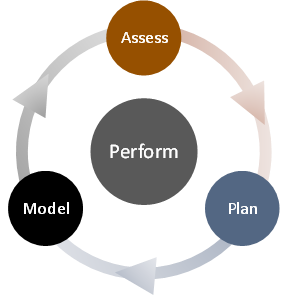
An “assessment” establishes the current state of your Company and its operating environment by examining the “elements” of your business in detail: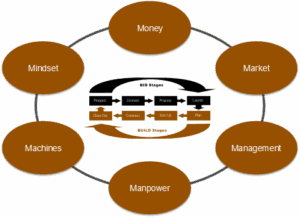
- Money
- Market
- Management
- Manpower
- Machines
- Mindset
The “business plan” documents the Company’s direction and how its objectives will be accomplished.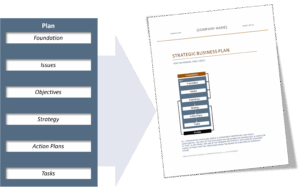
Foundation
- The Mission Statement is a brief description of what your company is striving to become or achieve; for example:
- EXAMPLE COMPANY, is committed to calculated, responsible achievement of its goals while providing its clients high quality work through ethical business practices and providing its employees a safe, healthy, rewarding and enjoyable work environment.
- The Value Statement is a brief description of the core principles that drive your business decisions; for example:
- In the pursuit of its mission, EXAMPLE COMPANY holds true to its values of safety, quality, customer service and integrity.
Issues
- Issues are those vital matters that must be addressed to fulfill the Mission; for example:
- Because we often subcontract work, the timing of the payments we receive for it leaves us short on cash.
Objectives
- Objectives are those vital goals that must be accomplished to fulfill the Mission; for example:
- We will manage cash flow in the next year such that we require no more than a $1M credit line while keeping all of our A/P current.
Strategies
- Strategies are those careful methods of achievement required to accomplish the stated Objectives; for example:
- We will bid more highway work and front load our prices to accelerate cash receipts.
Action Plans
- The Action Plan establishes exactly how a strategy will be executed by identifying the activities that must be undertaken, their timing and order; for example:
- Hire a dedicated highway estimator this month.
Tasks
- Tasks are just that, small activities that must be accomplished day-to-day to implement the plan, along with the assignment of responsibility; for example:
- Hire a headhunter by the end of this week – Greg.
Three “models” define what operations will look like under the plan and thus test the plan’s viability:
- Ideal Business Model
- Ideal Organization Model
- Ideal Financial Model
Ideal Business Model
The IBM defines the properties, sequence and timing of those tasks involved in the ideal execution of day-to-day operations.
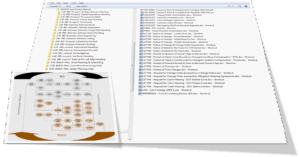
Grantlun can get you started using its already establish “Core Process Network” which documents best practices in the BID-BUILD work flow.
Each process in it is charted step-by-step with a “TaskMap” and a set of supporting documents.
Ideal Organization Model
The IOM defines those business functions and attendant roles ideally needed to operate according to the IBM. It also defines the positions in the company’s organization needed to fulfill each of the business functions’ roles.
Ideal Financial Model
The IFM defines the cost of the positions established in the IOM; and, using revenue and cost assumptions, as well as cost and financial history; forecasts financial results; and, sets the business plan’s standards of success.